Friday, June 25, 2010

China - May 2010

This spring I was presented with a rather abrupt opportunity to spend two weeks in China for work. I of course jumped at the chance. Despite having been to foreign and exotic places like Canada, I wasn't so sure how things would go for me. After all, I'd be disoriented in a place that doesn't even use an alphabet that I'm familiar with. Fortunately for me, I was able to manage just fine with the assistance of many helpful people and the trip largely went off without a hitch. There were times when I loved it, and times when I was quite ready to leave. Even after having been home for a month, I'm still digesting the experience and I suspect I will for some time.

After a 15 hour flight over the Arctic, my traveling partner and I arrived in Hong Kong. While we immediately left the city for our other more pressing destinations, I got the impression that it was a beautiful place. This is the only picture I got, as we left the city in a hired minivan.

Upon waking the next day, I decided to venture out into the streets on my own for an early morning run. I largely had the place to myself.

There were some familiar things to encounter right away...


And some not so familiar.


Most cities I went to had wide open public places with interesting artwork.


This was a nearly constant sight; new construction was everywhere I looked.

They're usually building large apartment and office buildings like this.

The streets and highways were deserted in the morning...


Which was a bit of a contrast to later in the day. Chinese traffic and driving habits are never dull.


This was the main street in a smaller town that I visited. German luxury cars shared the road with scooters and strange farm truck contraptions.


Chinese industry has frequently been noted for copying other designs. This BYD looks an awful lot like a Toyota Corolla. You can even buy a Toyota badge right at the dealership, should you wish to complete the impression.


Many of the Taxis I saw were Volkswagen Jettas. This particular body style was last sold in the U.S. in the early 90s. I want one.


Motorbikes and scooter are very popular modes of transportation. This is an employee parking area at a factory.


Various forms of motorbike are used to transport nearly everything. Here, we have a recycling delivery. The cardboard, not the person.


Luckily there are many signs to assist hapless foreigners in their travels.


I was going to send a loogie onto the subway platform until I saw this one.


Traveling from place to place, there were always cool things to look at. Some of them were natural...


...and some of them were not. The smog was terrible at times.


A cool monument of some sort.


One of the more adventurous things I got to do was try new foods. Would you care for a pickled snake?


Or perhaps some octopus. This guy was particularly good.


I'm not sure what these are. Some sort of sea worm?


Apparently they also serve dinosaur.


While waiting in a bus station, I tried a local version of an American snack. Despite the cool looking dude on the front, the chips were terrible.


These shrimp crackers, on the other hand, were alright.


Should you wish for a taste of home, there are many familiar fast food joints.


Some even have a fleet of bicycles ready to deliver!


Or perhaps your tastes run a little more local.


In one city we got to walk around at a really nice local park.


There were many pathways through the bamboo.


Many of them had rather intricate stone work.


We were able to catch a bit of a view of the city from a hill top.


While waiting one of my flights to take off I was able to count 25 cranes out my window. There should be 9 in just this picture.


Traveling between cities we passed this enormous power plant. Those smoke stacks are well over 500 feet tall.


At one point we took a ferry and went by this cargo container terminal.


The last city on our trip was Shanghai. We spent some time at night on a river walk known as the Bund. The view across the river was spectacular.


Our side of the river was equipped with light-up waterfalls and search lights.


The riverbank in the other direction.


This is the Peace Hotel, a Western building left over from colonial times.


The boats light up too.


Even the old-style ones.


Space needles and gigantic bat buildings: they just go together.


Walking a bit further down the Bund...


...we ran across this monument of sorts.


I'm not sure what the specifics of it are...


...but I suspect it was a tribute to the communist revolution.


One of the few explicit signs of communism that remember encountering in China.


Looking up from directly beneath the monument was pretty cool too.


On the last day of the trip we visited the Shanghai Expo. It was essentially a modern day world's fair. With over 400,000 people per day visiting, the line to get in was very long.


Each country had it's own pavilion. In the interest of international peace and brotherhood, I visited Iran first.


Iran's glorious rulers.


I even bought some Iranian ice cream and had a brief but pleasant conversation with the Iranian girl who served me.


Conveniently next door was North Korea.


It was a popular place.


"Paradise for People" - nope, no gulags here.


I hoping to see a bit more propaganda.


I'm pretty sure this was Taiwan's pavilion. There was this enormous spherical television screen inside.


The United Kingdom's building was the most impressive. It's too bad that this was the best picture I was able to get. Shortly after this it started raining.


I sought shelter inside of Slovenia, which was kind of rave-like.


Too long of a line to get into Kazakhstan. No sign of Borat either.


China's exhibit was characteristically over-the-top.


Saudi Arabia came complete with palms trees and a light up camel banner.


There were elaborate sculptures nearly everywhere.


No World's Fair would be complete without a gigantic flying saucer.


On our way to the airport in Shanghai, we took an electric rickshaw to the metro station. I think the yellow sign in the upper right is telling me to watch out for someone struggling to open an umbrella.


Then we took the MagLev train to the airport. It went over 180 miles per hour, and goes even faster at other times of the day.


On the flight home I got to see Japan from 30,000 feet. It looks very mountainous.


While I did get to see about a dozen different cities in my two weeks in China, I of course only scratched the surface. This shouldn't be surprising for a country of 1.4 billion people and thousands of years of recorded history. In the end I left in much the same state as I arrived - rather confused.

Saturday, June 5, 2010

Race Report: 2010 Massanutten Mountain Trails 100 Miler

After running my first 100 miler last year in Vermont I slacked off. I felt like I’d reached the top. I had it made. What else was there to do? A combination of needed recovery time and self-satisfaction allowed me to coast through the rest of the summer without much in the way of running discipline. This came back to haunt me in the fall when I was taught a hard lesson in preparation at the Cape Cod Marathon.


By December, the urge to challenge myself once again began to crop up and I decided that there had been something missing from the Vermont 100. I hadn’t found everything I was looking for. One hundred milers are supposed to be grueling. You’re supposed to want to quit, or so I was told. All I’d heard about were gruesome blisters, hallucinations, and stories of triumph over agony. I expected to be tested to my very limits, to break through impossible walls of endurance. But, to be blunt, I was a little let down. I blew away every single time goal I had and, while my feet were mincemeat and the rest of my body felt like it had been worked over with a hammer, I never truly had to scrape the bottom of the barrel. Time to turn it up a notch.


I’d heard only good things about the Massanutten Mountain Trails 100 Miler in Virginia. I’d also heard it was substantially more difficult than Vermont, so I signed up. I’d be adding another 4,000 feet of cumulative elevation gain, plus another 1.8 miles of distance. Compared to the Vermont 100, I traded smooth dirt roads for ankle-rolling rocky single track and expected to be on the move through the night and well into the next day.


Still, I found myself at the starting line on race day without the same sense of fear as before. I never heard the race director say “go”, but the mob around me started to move so I just went with the flow. From the very start I hooked up with David Snipes, a Virginia local and 6 time MMT finisher. He informed me that we were now “married” and would have to stick together and look after each other for as long as possible. He’d guide me, an MMT rookie, and have the pleasure of my always-sunny disposition in return.


We covered the first few miles on a dirt road under headlamp, then turned off into the woods at Moreland Gap on our first trail section of the day. The footing here was a taste of things to come, with rocks jumbled haphazardly about the trail. They required a bit of attention to foot-placement, especially with dead leaves concealing some of the holes, but were nothing I hadn’t experienced before. We hiked up Short Mountain, which was steep and long by running standards, but moderate by hiking standards. I was a bit surprised when we arrived on the top of the ridge so quickly.


The Massanutten Mountains are a series of long, mostly smooth, ridgelines with an isolated valley in between them. Once atop Short Mountain, we ran along the top of one of these ridgelines for several miles with only minor elevation changes before a long descent back down to a road in the valley and the next aid station. This was a pattern that would become very familiar throughout the day. Snipes made an excellent tour guide, pointing out the remnants of a stone wall that was built along the ridge top under orders from George Washington to fortify the central valley against the Red Coats during the Revolutionary War.


My wife, Miriam, had traveled down to Virginia with me and was waiting at Edinburg Gap, the first crew accessible aid station. She snapped a few pictures, swapped out my empty bottles for full ones, and resupplied me with gels before we were back on our way. Miriam works hard to support me at my races and I always appreciate her help. During the course of the event, she would stay awake for 36 hours and drive over 150 miles to keep me taken care of.


Another climb and ridge run brought us through Woodstock Tower, where a powerline swath is cut through the trees. We could hear quite a racket ahead and, as it turned out, there was a helicopter buzzing around doing tree work to maintain the area around the lines. The rocks through here were a bit technical to run and I felt my legs being worked in unusual ways. I hoped I’d be able to withstand another 75 miles of this. Somewhere around five hours, thirty minutes in, we passed the marathon mark. It was 10:30 in the morning and just starting to warm up. Though the high temperature for the day would only be in the 70s, I was beginning to feel the heat. I don’t normally enjoy hot weather and the humidity made me wish I’d evolved a set of gills, though it didn’t seem to bother the locals at all. I felt the familiar sensation of a bonk coming on; the cloudy psychological state, flagging energy levels, and a general grouchiness. I’ve always written this off to a deficient nutrition plan, but I’d been eating a gel every 45 minutes without fail since the start and I now think there must be more to it. I got my usual bags under my eyes and starting staring off into space, something Dave noticed as well.


We found ourselves running a dirt road section next to the winding Shenandoah River, with little shade. Though we were able to make good time here, I hoped we’d be back on the trail and under tree cover soon. At the mile 53 aid station, Habron Gap, they had a grill set up and I scarfed down hot dogs and tater-tots as quickly as they could be set in front of me. I was starving and growing very sick of gels. Here, I ran into Bob Ayers, a familiar face from Vermont. He’d stubbed his toe pretty badly early in the race; it was swollen and red and he wasn’t sure he could make it to the next aid station before dark. Having brought a plethora of headlamps, I lent him one of mine and convinced him to at least get himself to the next aid station. He made it there, where he was pulled from the race and sent to the hospital, his toe broken in three places.


David and I arrived at Camp Roosevelt, mile 63, at dusk after having been running for over 15 hours. Here, he’d pick up a friend to pace him through the night. I intended to stick with them, not having a pacer of my own. While David ate and took a breather, I took my shoes off to take care of some developing blisters. Generally, in a race this long I keep my shoes laced rather loosely. On the rocks this had caused some blistering on the outer sides of my feet, which I felt needed to be drained. Immediately after puncturing the dead skin, I thought I’d made a colossal mistake. The dull throb of the full blisters was replaced with sharp, acute pain. It was painful to even stand. I told David that I was going to start walking and that I was sure he would catch up soon.


I hobbled out of the aid station into the dark, a bit angry at myself, but it wasn’t long before the pain in my feet began to fade. My blisters went numb, and with the evening temperatures back to a comfortable level, I actually starting feeling rather energetic. My head cleared, my muscles felt little fatigue, and I was actually enjoying myself again. I cruised through the woods at a comfortable pace, passing a group of boy scouts around a large campfire at one point. They’d figured out that a race was going on right through their campsite and they cheered me on as I flew by.


Here, things began to blur a little bit. I went up a climb known as Jawbone, then across Kern’s Ridge in the dark, reputed to be the rockiest section of course. I was slowing down to a more reasonable speed and feeling rather sleepy. Miles blended into each other and I got a bit jumpy. On top of Bird Knob I felt like I needed a short nap, so I began looking for a suitable spot to sit down and close my eyes. One rock the size of an office chair on the side of the trail looked inviting, but when I put my hand on it, it turned out to be an enormous anthill. I frantically brushed all the bugs off my arm, which woke me up for a bit, but I finally just settled on lying down on the ground in the middle of the trail for five minutes. It wasn’t very refreshing, but there were no ants, and it helped a bit.


Eventually, the sky began to lighten and I was able to put away my headlamp. I found myself walking more and more - not so much because of crippling fatigue, but because I was having a lot of stiffness in the crotch of my knees where the calves and hamstrings connect. I was also developing so healthy blister pain on both pinky toes where my feet had swollen up. I wore the same pair of Cascadias for the entire race, even though I have a half size larger pair in my aid kit. Next time I’ll have to remember to changes shoes before my feet swell up and cause additional blistering.


I arrived at the last aid station, Gap Creek II, and only had 6 miles to go. Miriam, who wanted to experience a portion of the course for herself as well as witness what the last bit of a hundred miler is like, decided to accompany me for the last few miles. We ascended slowly up and over the last climb and came out on the last section of road. By this point I knew I was going to finish well under my 30 hour goal and I decided that I didn’t really care whether my time was 28 hours or 29 hours, so I walked much of it. Had I been able to motivate myself I’m sure I would have been able to run this entire section and cut some time off. I was feeling a little out-of-sorts. My legs itched furiously and I’d suddenly lose focus and become fixated on checking myself for ticks, with only a mile to go. Looking back, this seems like a ridiculous waste of time, even though I found three of the little buggers.


We turned off the road and onto the final 0.6 mile section of trail and I looked behind me. The first runners I’d seen in over an hour we’re catching me and I was determined not to get passed on the home stretch. My focus came back and I began to run everything, even the uphills. With only a few hundred yards to go I found the pain in my legs begin to fade, as it always does, and I was able to sprint away from Miriam. The trail took a few sharp bends within sight of the finish and I was going so fast that I almost ran off into the trees. I made it through the gate and finally was able to stop. Spectators clapped and the race director shook my hand and congratulated me. My final time was 28:50, which I was more than satisfied with.


Photo by Bobby Gill


After the race, it was good to get some food and well deserved sleep before heading back to the finish area to welcome other runners in. I was particularly impressed with the very last finisher, who finally succeeded at Massanutten on her fourth attempt. Despite the fact that she finished seven hours behind me, I had to wonder if I’d have the same determination, given similar circumstances. I don’t even know her name, but I admire her strength.


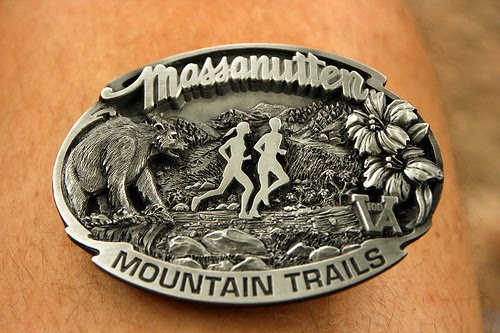
With my new buckle in hand, I look back on Massanutten as a very enjoyable race but I must say, I still haven’t found that impenetrable wall I’ve been looking for. I have a few ideas for where to look next, but in the mean time I have to wonder whether it even exists.


Photo by Bobby Gill